Diverse developers and a project lead reviewing monitoring displays in a dark control room

Technology compass

Technology

The stack follows the system.

LatentDrift designs and builds specialized technical AI systems for agentic systems, latent state management, evidence layers, knowledge spaces, real-time interaction and control rooms. We translate current research into interfaces, orchestration rules, trace schemas, evaluation sets, real-time state models and release rules. The result is an architecture sprint, a pilot implementation or a focused system component with a clear review trail.

  • Latent state
  • Real-time UX
  • Explainability

System field: latent agents

Working memory for agents.

LatentDrift works on latent agent coordination because the bottleneck in many multi-agent systems lies in state handoff. We build working memories, adapters and fallback paths: what an agent may pass internally, what must be documented as a readable trail and when an explicit text handoff is safer. One concrete deliverable is an agent-memory plan for research, planning or review processes.

Shared working memory

Agents can coordinate tasks, intermediate results and internal state through controlled working memories instead of translating every intention back into verbose language. In practice that means clear write paths, a consolidation step for compression and contradictions, and a read path that retrieves only the relevant context.

Use case: a casework cockpit where a research agent collects source passages, a planning agent prepares steps and a review agent exposes only the relevant state slices to the domain expert.

  • Clear write paths
  • Compress contradictions
  • Retrieve relevant context
  • Fewer text handoffs

Alignment and boundaries

Latent channels are powerful and security-sensitive. We therefore design separation, permissions, leakage tests and auditable handoff points from the start. Sender-receiver alignment, model or layer changes and the point where latent state is mirrored into an inspectable text trail are especially important.

Service: LatentDrift defines channel boundaries, test cases and text fallbacks so direct agent communication can reduce latency without losing later review.

  • Channel boundaries
  • Permissions
  • Leakage tests
  • Mirrored text trail

Traceability for invisible state

What cannot be read directly needs especially strong observability: run history, state transitions, metrics and understandable explanation layers for domain users. For production systems this means state diffs, token and latency budgets, reproducible runs and an explicit fallback when the latent channel cannot be explained well enough.

Deliverable: a trace schema that links invisible handoffs with summaries, state diffs, model version, cost and review status.

  • Run history
  • State transitions
  • Cost/latency budgets
  • Explainable fallback

System field: agentic systems

Orchestration as operating layer.

Agentic systems add value only when orchestration, execution and control are mastered. LatentDrift builds operating layers that make roles, routing, tool permissions, scheduling, observability, verification, recovery and human gates controllable. Whether that layer is called a harness, runtime or orchestrator is interchangeable; the durable concern is the operating rules that define which agent may act, when it may act, and how a run can later be explained, stopped or repeated.

Roles, routing and scheduling

An agent system needs more than prompts. It needs a role graph, task router, budget rules and priorities: who may plan, who may execute, who checks the result, and when is a task stopped or escalated to a human? LatentDrift expresses these rules as operating configuration so they are observable during the run and adjustable after it.

Use case: a procurement or support workflow where one agent gathers data, another prepares options and a third writes only approved suggestions into a domain system.

  • Who plans
  • Who executes
  • Who checks
  • When to escalate

Direct and latent communication

Direct agent channels can reduce text handoffs: embeddings, hidden states or KV state carry more context than long messages. In production this becomes useful only with visible commitments, text fallbacks, sender-receiver alignment and security checks. Every invisible handoff needs an inspectable counterpart: summary, state diff, approval or interruption reason.

Service: we design direct agent channels only where they improve latency, cost or quality while remaining attributable through commitments and review points.

  • Reduce text handoffs
  • Visible commitments
  • Sender-receiver alignment
  • Inspectable counterpart

Observability, verification and recovery

The operating layer records trajectories, tool results, intermediate state, interruptions and approvals. Validators, reset points and human gates ensure that a run is convincing, repeatable, analyzable and bounded. Multi-agent systems add value when this execution layer is mastered.

Deliverable: a working operating-layer component with run traces, validators, rollback rules, escalation points and a clear line between autonomous step and human approval.

  • Trajectories
  • Tool results
  • Reset points
  • Autonomy boundary

System field: system decisions

Decisions for reliable operation.

LatentDrift turns technology options into decision work. In an architecture sprint we define which states, representations, control policies, retrieval qualities, streaming rules, release levels and evaluations should carry the system. Those decisions are documented as an operating specification so the later implementation is based on reviewable assumptions.

State and memory

Which information is persistent, session-bound or held only inside one agent run? That separation shapes retrieval, cost and risk. Modern agent-memory work frames this as a write-manage-read loop: writing, consolidation, forgetting and recall are separate design decisions.

Service: memory scope and deletion logic for agent systems so knowledge becomes useful without retaining every interaction indefinitely or losing control.

  • Persistent or session
  • Only inside a run
  • Write and consolidate
  • Forget and recall

Latency and interaction

A live interface, a cockpit and a batch workflow need different response times. That determines streaming, model choice and UI behavior. Real-time systems also need to handle partial results, interruptions, corrections and unstable context at the interface level.

Use case: a real-time review flow where partial answers stay visible, a domain expert can interrupt and the system switches cleanly between suggestion, question and handover.

  • Response times
  • Streaming
  • Interruptions
  • Partial results

Evaluation and release

A system needs test cases, error classes and release rules before it receives more autonomy. Otherwise only uncertainty grows. For RAG systems, retrieval, generation, safety, efficiency and source grounding need separate checks. Explanations themselves also need review because natural-language LLM rationales can diverge from the actual decision path.

Deliverable: an evaluation and release set with error classes, source checks, explanation quality, cost/latency and clear criteria for more or less autonomy.

  • Test before autonomy
  • Error classes
  • Check source grounding
  • Review explanations

System field: evidence layer

Evidence as system layer.

Explainability belongs in the architecture as a system layer. LatentDrift offers the Evidence Layer as its own system component: provenance, role-specific explanations, evidence graphs, evaluation reports, model/data cards and handover rules are built into the architecture. Especially in public-sector or regulated settings, this is the difference between a plausible output and a reviewable AI system.

Provenance and evidence graph

Every relevant output needs a reconstructible trail: request, data status, source, chunk or dataset, model version, prompt/tool configuration, intermediate state and approval. This becomes an evidence graph linking answer, source and system execution and later supporting domain correction, audit or model replacement.

Use case: a records or document review where every recommendation links back to source passage, rule, model run and review status.

  • Request and data status
  • Source or chunk
  • Prompt/tool config
  • Approval

Explanation standard per role

A good explanation is different for a domain expert, end user, operator and auditor. We therefore define explanation standards: what needs to be understandable, which uncertainty must be visible, which limits apply, and when a rule or source needs to carry the answer. Explainability becomes an interface between system execution, user surface and responsibility.

Service: role-specific explanation layers for domain teams, operations, audit and end users so not everyone has to see the same technical trail.

  • Fits the role
  • Uncertainty visible
  • Limits named
  • Rule or source

Public-sector evidence base

Public and regulated environments need technical evidence: documentation, logging support, data quality, model and dataset cards, evaluation reports, access control and clear handover. This does not replace legal review; it provides the necessary engineering groundwork for reviewable AI.

Deliverable: an evidence package that combines technical documentation, test status, known limits, data quality and handover decisions.

  • Technical docs
  • Logging capability
  • Data quality
  • Access control

System field: real-time interaction

Real-time with clear state.

The important capabilities sit below the surface: streaming, interruption logic, turn-taking, reaction modeling, context state, visual output, identity control and safety rules. LatentDrift offers this as a Real-time Interaction Layer. An avatar is one possible use case and can be built as a tailored interface; the same layer can also support a cockpit, speech dialogue or review process. What matters is that every switch between listening, thinking, speaking, waiting, aborting and handover is handled as explicit state.

Use case: a training or service interface that can be interrupted, asks follow-up questions under uncertainty, optionally adds visual presence and always hands over into a human review flow.

  • Listens, waits and interrupts under control
  • Responds to voice, gaze and context shifts
  • Explains state, uncertainty and next action
  • Hands over cleanly to human review

Delivery architecture

System first, then technology choices.

We select frameworks, models and infrastructure only after state, latency budgets, data rights, release paths and UI behavior are described. The stack follows the system specification. Technically, our system components become three resilient layers: data and evidence, inference and routing, review and control.

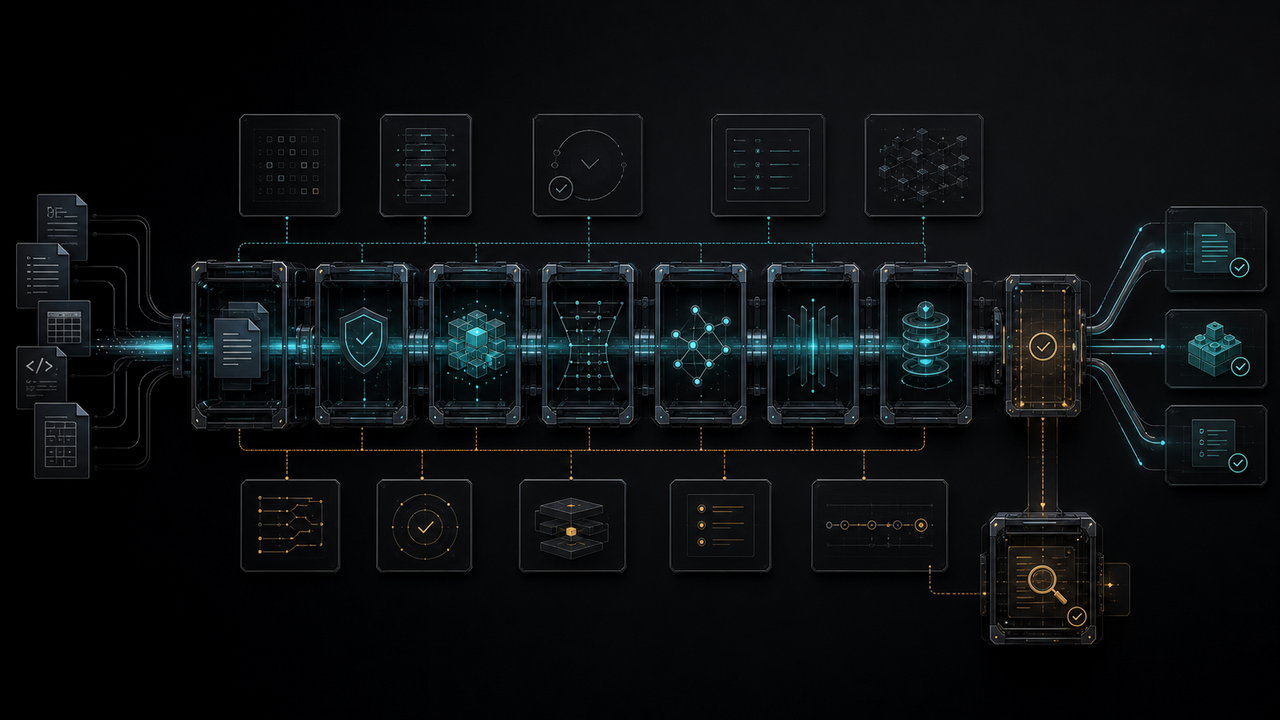
Dark RAG backbone with parsing, permissions, embeddings, graph, re-ranking, source-weighting, evidence-log and review chambers
Context layer

Data and evidence backbone

Parsing, permissions, embeddings, hybrid search, knowledge graphs, re-ranking and source weighting are built as a traceable knowledge space. Good RAG architecture checks ranked results and every relevant statement for support, freshness and allowed context. Dataset cards, freshness rules, chunk provenance, evidence logs and review paths belong to the layer.

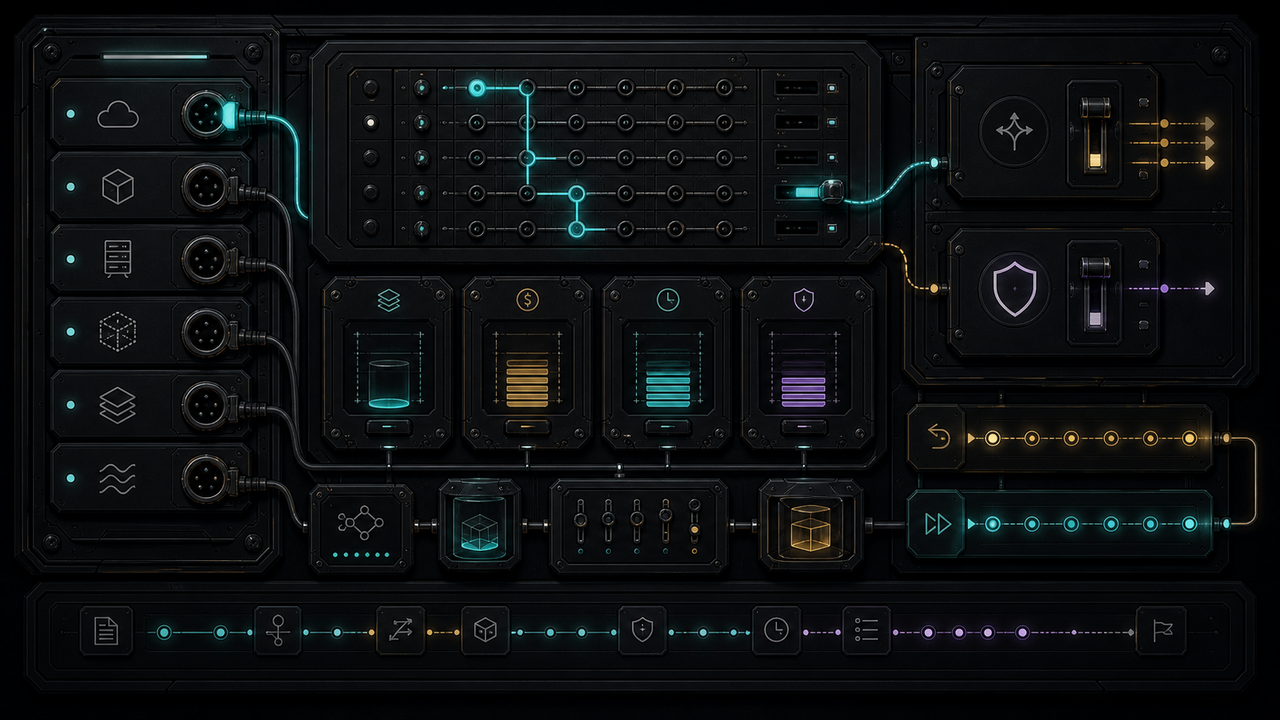
Dark routing switchboard with model sockets, context, cost, latency and privacy budgets, fallback switch and attribution trail
Inference policy

Inference and routing policy

API models, open weights, local inference, quantization, batch behavior and streaming are decided by the system specification. The policy describes which model is used under which context, cost, latency and privacy budget, when fallback applies and how model version, prompt/tool configuration and result quality stay attributable per run.

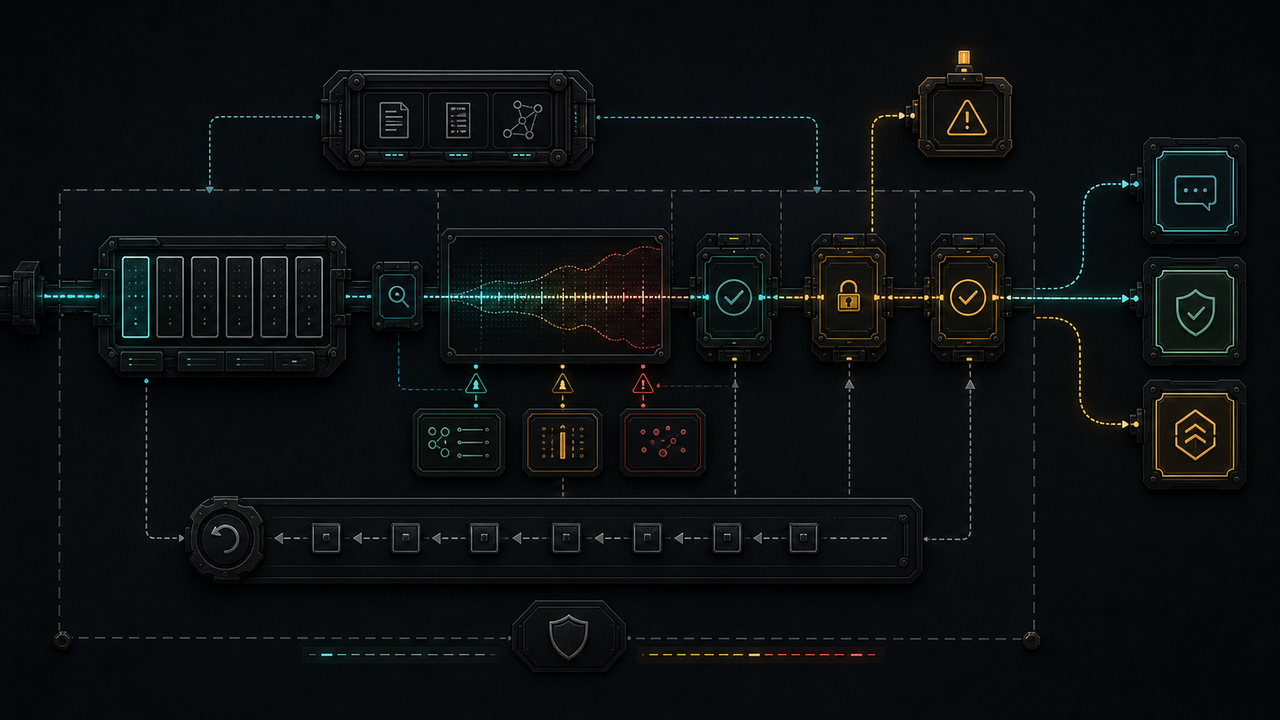
Dark control layer with review queue, uncertainty band, approval gates, rollback rail, audit capsule and escalation channel
Responsibility layer

Review and control layer

Review flows, approvals, uncertainty, interface fallbacks, audit and technical documentation form the operating layer. Autonomy is increased only when tests, source grounding, handover, explanation quality and safety boundaries stay stable in real scenarios. Review queues, rollback rules and visible states show whether an output is a suggestion, reviewed decision or escalation.